











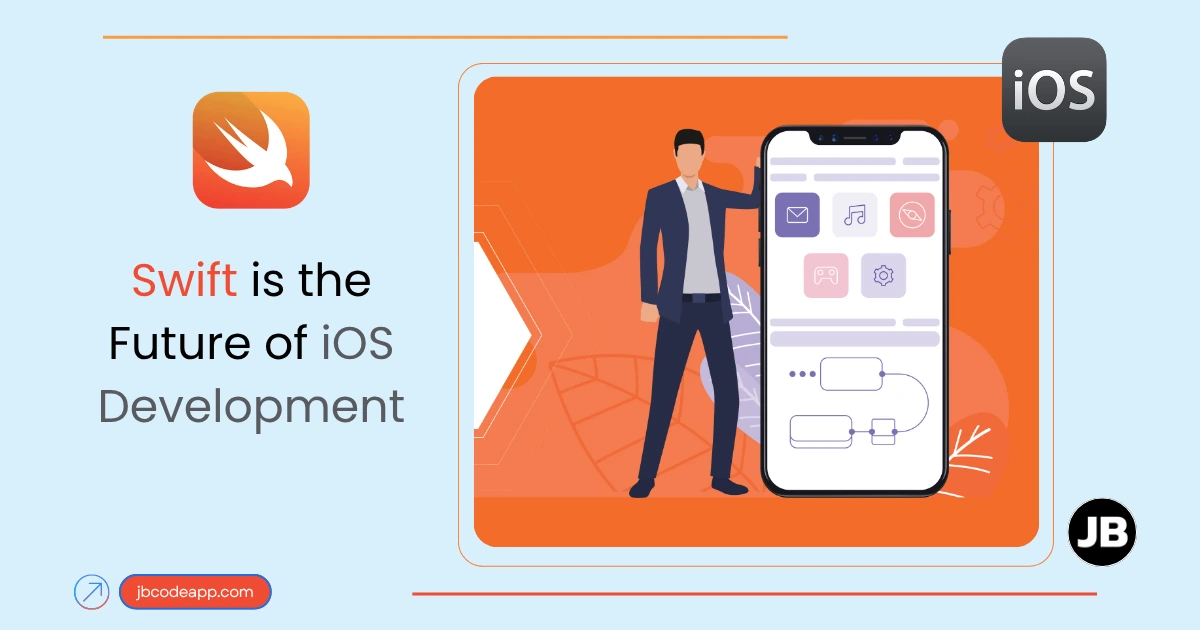
Swift is the Future for iOS App Developers
Overview
Table of Contents
- A Brief History of Swift
- What is Swift and Why Is It Gaining Traction Among iOS Developers?
- Why Swift Is Preferred Over Objective-C for Modern iOS Development
- How Swift Enhances App Performance and Developer Productivity
- What Makes Swift a Safer Programming Language?
- Where Is Swift Being Used Beyond iOS Development?
- How Swift's Open-Source Nature Benefits Developers
- What Challenges Do Developers Face When Adopting Swift?
- Why Swift Is the Future of iOS App Development
- Why Developers Prefer Swift Over Other Languages
- How JBcodeapp Helps You Build iOS Apps with Swift
Swift has rapidly become the go-to programming language for iOS app development—and for good reason. Introduced by Apple in 2014, Swift was designed to make coding more approachable, safer, and faster for developers. Over the years, it has evolved into a powerful tool that not only improves developer productivity but also enhances app performance and security.
From startups building MVPs to enterprise-grade platforms with complex user interactions, Swift is powering apps across industries. With its modern syntax, strong typing system, seamless integration with Apple’s ecosystem, and vibrant open-source community, Swift has outpaced Objective-C as the preferred choice for iOS development.
Whether you’re a business looking to build a high-performance iOS app or a developer exploring future-ready languages, this blog will walk you through why Swift is shaping the future of iOS—and how you can leverage its features to build better, faster, and more secure applications.
A Brief History of Swift
Swift didn’t appear overnight. It began in 2010 as a secret project by Apple engineers who wanted to build a modern language tailored for Apple's ecosystem. Officially launched in 2014, Swift was designed to improve upon Objective-C by reducing boilerplate, improving safety, and increasing speed.
Unlike its predecessor, Swift was built with developers in mind—easy to write, safe to run, and powerful enough for production-level applications. It marked the beginning of a new era for app development across Apple platforms.
What is Swift and Why Is It Gaining Traction Among iOS Developers?
It was built to improve code clarity, safety, and speed over its predecessor—Objective-C.
Unlike older languages, Swift simplifies the app development process. It’s intuitive for beginners yet powerful for experienced developers. Its open-source nature also means the community is rapidly expanding with new features and support.
Real-World Example: LinkedIn began integrating Swift into their iOS app in phases. They reported cleaner code, faster compile times, and easier onboarding for new developers due to Swift's readability and modern syntax.
“We chose Swift over Objective-C due to its safety features and development speed. It allowed our team to reduce bugs and ship updates faster.”
Why Swift Is Preferred Over Objective-C for Modern iOS Development
The shift from Objective-C to Swift isn't just a trend—it's a strategic move for forward-thinking developers and companies. Swift addresses many of Objective-C’s shortcomings, including outdated syntax and memory management challenges.
The shift to Swift is driven by:
- Simplified syntax that’s easier to write and understand.
- Fewer bugs thanks to safety features like optionals and type inference.
- Faster development with less code and more compile-time checks.
Many companies, including Lyft, have migrated to Swift and seen reduced code size and performance gains.
“Swift is a powerful and intuitive language that gives developers the freedom and capabilities they need.” – Apple Developer Documentation
How Swift Enhances App Performance and Developer Productivity

One of Swift’s standout strengths is its ability to improve both runtime performance and developer workflow. By leveraging the LLVM compiler infrastructure, Swift translates code into highly optimized native binaries. This results in faster app performance, smoother animations, and a significant reduction in memory-related crashes—something that’s crucial in high-traffic iOS applications.
Swift also embraces modern programming paradigms, enabling developers to write clean, efficient, and reusable code. Its expressive syntax requires fewer lines of code than Objective-C, making development not only faster but easier to maintain over time.
Key Developer Productivity Boosters::
-
Automatic Reference Counting (ARC) : Swift automates memory management, reducing the need for manual garbage collection and minimizing memory leaks.
-
Swift Playgrounds: Especially useful for onboarding or prototyping, this tool gives instant feedback so developers can test features quickly.
Real-world example: Airbnb adopted Swift to streamline their iOS architecture and saw significant improvements in reliability and speed.
What Makes Swift a Safer Programming Language?
Swift was designed to eliminate entire classes of common programming errors, particularly those that plagued Objective-C. One of its most notable features is type safety, which ensures variables are used consistently and correctly. This reduces runtime errors and improves code clarity across teams.
The introduction of optionals—a Swift-exclusive feature—forces developers to explicitly handle the possibility of nil values. This simple change dramatically reduces unexpected crashes from null pointer exceptions. Additionally, Swift’s compile-time checks allow developers to catch mistakes early, saving countless hours during debugging.
Why Safety Matters:
-
Memory safety through ARC (Automatic Reference Counting).
-
Immutable values by default using let, which reduces accidental changes.
-
Structured error handling through try, catch, and throw.
Swift eliminates entire classes of errors common in Objective-C:
- Strong typing system prevents data type mismatches.
- Optionals and
nilsafety reduce crashes from uninitialized variables. - Compile-time checks help catch bugs before runtime.
“Swift saved us countless hours debugging memory issues that were once common in Objective-C.”
Want to launch your next iOS app in Swift? Talk to our mobile experts today!
Where Is Swift Being Used Beyond iOS Development?
Swift’s reach is no longer confined to iOS and macOS. As it matures, the language is being embraced in non-mobile environments, enabling developers to build full-stack applications with a single language.
Swift is increasingly used in server-side development through frameworks like Vapor, which makes it possible to build RESTful APIs and backends. This makes Swift a strong competitor to Node.js, Ruby, and Python in backend systems.
Swift has also entered machine learning domains, with tools like Swift for TensorFlow, allowing native ML integration within Apple ecosystems. Thanks to its growing support on Linux, Swift can now be used to build CLI tools and backend logic for cross-platform apps.
Real-World Use Cases:
-
IBM and Perfect.org have explored Swift for cloud-based services.
-
Cross-platform teams are using SwiftUI and server-side Swift to unify development efforts.
-
Swift’s type safety is even beneficial in systems programming where stability is crucial.
Swift is no longer limited to mobile. It’s evolving into a multi-purpose language:
- Server-side development using frameworks like Vapor.
- Cross-platform apps using SwiftUI and upcoming tools.
- Machine Learning with Swift for TensorFlow.
- Linux support for command-line tools and more.
This makes Swift future-ready for full-stack development and systems programming.
How Swift's Open-Source Nature Benefits Developers

Swift being open-source is a game-changer for the developer community. Since Apple open-sourced Swift in 2015, its growth has been fueled by community contributions, real-world testing, and transparent discussions. Unlike proprietary languages, Swift has a public roadmap, open issue tracking, and frequent updates that reflect real developer needs.
The Swift Package Manager (SPM) has made dependency management seamless, reducing reliance on external tools like CocoaPods. This has made Swift more stable and production-ready, especially in enterprise environments.
Furthermore, Swift’s active GitHub repositories and forums provide an incredible support network for developers, whether they’re beginners or seasoned iOS engineers. This openness accelerates learning and reduces development friction.
Open-Source Benefits:
-
Faster innovation with contributions from around the world.
-
Stronger security thanks to peer-reviewed code and open bug tracking.
-
Rich learning resources, including the official Swift Forums and GitHub libraries.
Being open-source, Swift is constantly evolving through contributions from Apple and the community. This includes:
- Swift Package Manager for easy dependency management.
- Transparent roadmaps and community governance.
- Wide ecosystem with GitHub libraries, forums, and learning tools.
What Challenges Do Developers Face When Adopting Swift?
Although Swift offers a modern approach to app development, developers may face a few transitional challenges:
-
Learning Curve: Developers accustomed to JavaScript, Objective-C, or Java may need time to adjust to Swift's syntax and strict typing.
-
Rapid Language Evolution: Frequent Swift updates can break backward compatibility, requiring ongoing education and refactoring.
-
Objective-C Integration: Working with legacy code or libraries may require bridging between Swift and Objective-C, adding complexity.
Despite these obstacles, most development teams find the long-term advantages—such as safety, performance, and cleaner syntax—far outweigh the initial friction.
Like any transition, moving to Swift has its hurdles:
- Developers from other languages face a learning curve.
- Frequent language updates require keeping up with documentation.
- Swift may require bridging when integrating with legacy Objective-C codebases.
However, these are temporary. The long-term benefits easily outweigh the learning costs.
“Swift’s onboarding was a challenge, but once we made the shift, our productivity soared and bug rates dropped noticeably.”
Build Scalable iOS Apps in Swift
Start Swift Development
Why Swift Is the Future of iOS App Development
As Swift evolves, so does its ecosystem. Apple is now using Swift not just for mobile, but across platforms like macOS, watchOS, and tvOS—and even server-side Swift is gaining traction. With support for AI frameworks, AR/VR, and seamless integration with tools like SwiftUI, Swift is positioned as the long-term language of choice.
Swift isn't just another language—it's Apple's clear vision for the future of iOS, macOS, watchOS, and beyond. Apple has made it the go-to language for new development, heavily emphasizing it in tools like Xcode, SwiftUI, and Swift Playgrounds.
Reasons Swift is here to stay:
-
Developer Demand: According to job platforms like Stack Overflow and Indeed, Swift developers are among the most sought-after in mobile development.
-
Innovation Ready: Swift is built for integrating with Apple’s latest technologies—ARKit, CoreML, SwiftData, and VisionKit.
-
Community Growth: The open-source model encourages global contributions, making it one of the most vibrant ecosystems today.
Swift is fast, safe, and expressive. It’s not just a tool—it’s a long-term strategy for building apps users love.
Why Developers Prefer Swift Over Other Languages
Swift continues to rise in popularity among iOS app developers—and for good reason. It’s not just Apple’s native language; it’s a modern, safe, and expressive language that helps developers write clean, maintainable, and high-performing code. Swift isn’t just an alternative to Objective-C—it’s a reimagined approach to mobile development optimized for speed, security, and scalability.
Let’s explore why developers—from beginners to enterprise teams—prefer Swift over other programming languages for iOS and beyond.
Modern and Intuitive
Swift was designed to eliminate the complexities that made older languages cumbersome. Its syntax is clean, expressive, and readable, which makes onboarding new developers easier and faster. The language uses type inference, string interpolation, and simple control flows, removing boilerplate code that used to clutter development cycles.
- Clear and concise code reduces bugs and improves team collaboration.
- Swift’s syntax feels familiar to developers from modern languages like Python and JavaScript.
- Great tooling support in Xcode, including auto-completion and inline documentation.
Designed for Safety
One of Swift’s core strengths is its focus on writing safe code. It eliminates entire classes of runtime crashes that were once common in Objective-C. Through features like optionals, strict type safety, and error handling, developers can catch bugs early at compile time rather than at runtime.
- Prevents null pointer exceptions with optional types.
- Enforces initialization before usage to avoid undefined behavior.
- Encourages safe patterns like
guardandtry/catchblocks.
This makes Swift a top choice for apps that handle sensitive data, such as in healthcare, fintech, or government solutions.
Performance and Power
Swift is built on the LLVM compiler infrastructure, which compiles code into high-performance native binaries. This ensures your apps run fast and make the most of Apple’s hardware optimizations—whether it’s rendering graphics, processing real-time data, or loading resources.
- Faster startup time and smoother runtime performance.
- Compiled to machine code, unlike interpreted languages like JavaScript.
- Suitable for performance-critical apps like games, video editing, and finance.
Swift gives you the performance of a low-level language with the expressiveness of a high-level one.
Beginner-Friendly
Despite its power, Swift is a surprisingly great first programming language. Its intuitive syntax and helpful error messages make it ideal for aspiring iOS developers. Apple also promotes Swift heavily through Swift Playgrounds, an interactive learning app that makes coding feel like playing.
- Swift Playgrounds allows experimentation with code in real time.
- Encourages problem-solving and creativity through interactive lessons.
- Integrated with Xcode, making it easy to transition from learning to real app development.
Whether you're a student or a founder looking to prototype, Swift has one of the smoothest learning curves.
Compatible and Flexible
Swift is not just built for the present—it’s made to last. Since Swift 5, Apple has ensured binary compatibility, meaning apps written in earlier versions (like Swift 4) continue to run on newer compilers without changes. This makes versioning, deployment, and team collaboration far more predictable.
- Reduce technical debt with forward compatibility.
- Mix Swift and Objective-C in the same project with minimal effort.
- Ideal for long-term enterprise applications and product scaling.
Compatibility means less time fighting your tools and more time delivering value.
Open Source and Community-Driven
Unlike many proprietary languages, Swift is open-source, hosted at swift.org. This means the community actively contributes to its features, bug fixes, and enhancements. It’s also supported across platforms, including Linux, making Swift useful beyond just iOS/macOS.
- Huge ecosystem of reusable Swift packages and libraries.
- Community-driven roadmap keeps the language modern and relevant.
- Frequent improvements based on real-world developer feedback.
Swift’s openness ensures it evolves quickly and stays ahead of the curve.
Interoperability with Objective-C
For teams managing older iOS codebases, Swift offers seamless interoperability with Objective-C. This means you can introduce Swift into existing projects gradually without rewriting your entire codebase. It provides the best of both worlds—modern development with legacy support.
- Easily access Objective-C APIs from Swift and vice versa.
- Migrate feature-by-feature at your own pace.
- Great for maintaining app stability while modernizing over time.
Pro Tip: If your team is maintaining an older Objective-C codebase, start migrating business logic to Swift for better safety, testability, and future maintainability.
How JBcodeapp Helps You Build iOS Apps with Swift
At JBcodeapp, we combine deep iOS experience with agile methods to help businesses—from funded startups to global brands—build better, faster apps with Swift.
Here's how we help:
-
Swift-Based MVP Development: We turn your app ideas into launch-ready MVPs using SwiftUI, Combine, and other modern iOS stacks.
-
Objective-C to Swift Migration: Have legacy code? We upgrade your app to Swift, improving speed, maintainability, and user experience.
-
AI & AR Integration: We incorporate CoreML, ARKit, and IoT frameworks into your Swift apps for real-world impact.
-
Test-Driven Development: Our QA-first culture ensures stable, scalable, and future-proof apps.
-
Full App Lifecycle Management: From ideation to launch and post-release support, we walk with you at every stage.
-
Swift Experts: From SwiftUI to Combine and CoreML, we specialize in modern Apple frameworks.
-
Legacy Migration: We migrate Objective-C codebases to Swift, reducing tech debt and improving performance.
-
Custom iOS App Development: Native Swift development for iPhone, iPad, and Apple Watch.
-
AI & AR Integration: We build intelligent, interactive apps using Swift-based ML and AR libraries.
-
Automated Testing: Ensure stability across devices using XCTest and CI/CD.

Build Your iOS App in Swift with JBcodeapp
Hire Swift experts who understand scalability, security, and speed.
Request a QuoteSee how Swift improves app security and performance—request a demo now!
Frequently asked questions
Not at all. While Swift was initially built for iOS, it's now widely used for server-side development using frameworks like Vapor, for command-line tools, and even machine learning projects with Swift for TensorFlow. Swift is evolving into a versatile, full-stack language.
Depending on the complexity and number of integrations, a basic MVP can be built in 4 to 8 weeks using Swift. With tools like SwiftUI, Xcode, and JBcodeapp’s agile workflows, we speed up prototyping without sacrificing code quality.
Yes, Swift is fully interoperable with Objective-C. This means you can use both languages in the same project, making it easier to gradually migrate old Objective-C codebases to Swift without rewriting everything from scratch.
Swift integrates seamlessly with XCTest, Apple’s official testing framework for unit, UI, and performance testing. You can run tests directly inside Xcode, automate builds with CI/CD, and catch bugs early through test-driven development.
Yes, within the Apple ecosystem. Tools like SwiftUI allow you to create apps that run on iOS, macOS, iPadOS, and watchOS with shared codebases. While not designed for Android, Swift does support cross-platform goals within Apple’s environments.
Absolutely. Swift is the preferred language when working with ARKit for augmented reality and CoreML for machine learning. This makes it an excellent choice for building modern apps with AI features, face tracking, object detection, and real-time AR.
Yes, Swift was built with performance and safety in mind. It supports modular code architecture, type safety, and strong compile-time checks, all of which make it perfect for enterprise-grade applications that require stability and scalability.
At JBcodeapp, we use Swift to build everything from fast MVPs to scalable enterprise apps. Whether it’s SwiftUI for beautiful interfaces, AI-powered experiences, or AR/VR integrations, our team leverages Swifts full capabilities tailored to client goals.
Share on

Jigar Patel
inJigar Patel writes blogs for IT companies on software development and emerging technologies, helping readers stay updated in the fast-paced tech world.